Many B2B companies are not struggling because their marketing team lacks effort or because their sales team lacks discipline. In many cases, both teams are working hard. Campaigns are being launched. Sales calls are being made. Reports are being reviewed. Meetings are happening. Yet revenue still feels harder to predict than it should, often because the company lacks a clear framework for building effective Revenue Growth Systems.
This perspective was recently explored in a joint executive webinar hosted by SmartFinds Marketing and Our Sales Coach, where SmartFinds CEO Melih Oztalay and sales performance strategist Ken Cheo discussed how modern B2B companies are strengthening their revenue infrastructure by aligning marketing visibility, conversion systems, and disciplined sales execution.
That is where leadership often gets frustrated. From the executive seat, it can look like the problem must be marketing or sales. The natural reaction is to ask whether more budget should go toward demand generation, more salespeople, a better CRM, or another tool that promises improved visibility into the pipeline. But that line of thinking can miss the deeper issue.
The real problem is often the lack of a connected marketing and sales ecosystem.
Strong B2B companies grow more consistently when they stop treating marketing, websites, lead flow, qualification, and sales execution as disconnected functions. They begin to see them as part of one operating framework. That framework is what we call Revenue Growth Systems.
Revenue Growth Systems are not about chasing one shiny platform or hoping a single campaign will solve a performance problem. They are about building the infrastructure that supports predictable revenue from the first digital touchpoint through the sales conversation and into closed business. When that infrastructure is aligned, growth becomes more measurable, more scalable, and more repeatable.
At SmartFinds Marketing, this is the lens we continue to use when evaluating how B2B organizations improve revenue performance. The companies that make the most progress are usually not the ones doing the most random activity. They are the ones that strengthen the full system behind revenue generation.
Revenue Growth Systems begin with the flow of revenue
One of the simplest ways to understand Revenue Growth Systems is to follow the actual flow of revenue from first visibility to closed business.
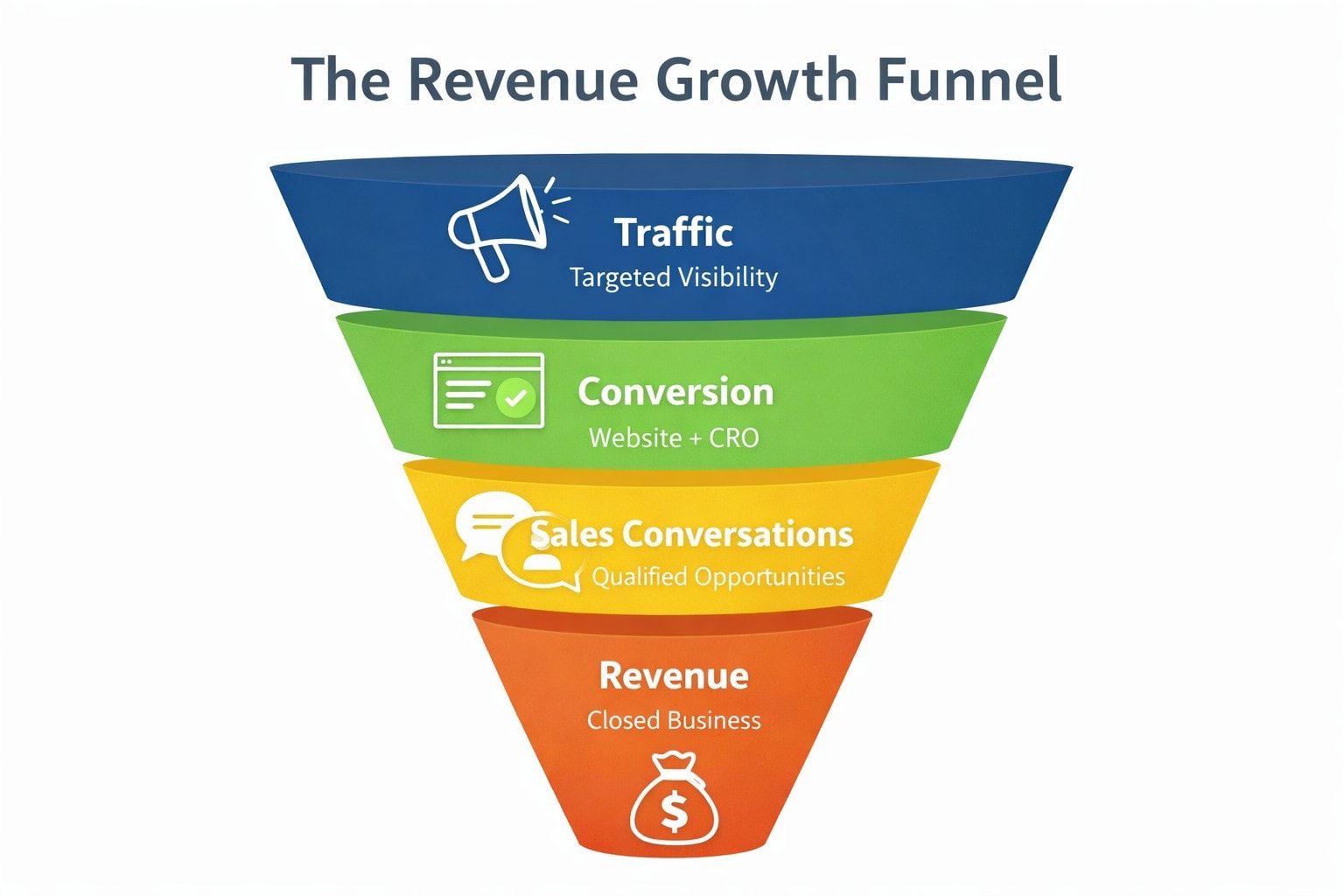
Revenue performance is often determined upstream. Weak inputs create friction for sales, while stronger inputs create better opportunities and more productive sales conversations.
That sequence sounds obvious, but many companies do not operate as if it is true. They often measure downstream outcomes while overlooking upstream causes. If lead quality is weak, sales conversations become harder. If the website creates friction, fewer prospects raise their hand. If traffic is poorly targeted, volume may rise while opportunity quality remains flat or declines.
This is why Revenue Growth Systems matter. Revenue does not begin when a salesperson sends a proposal. It begins much earlier, with the quality of the traffic entering the digital ecosystem and with the effectiveness of the systems that convert attention into real engagement.
Once leadership understands that, the conversation changes. Instead of asking only how to increase activity, the better question becomes: what is happening upstream that is shaping downstream performance?
Where B2B revenue systems usually break down
Most revenue problems do not show up all at once. They appear gradually in the form of friction.
“Too many companies try to fix revenue problems by adding more activity. More campaigns. More sales calls. More tools. But revenue rarely improves until the system itself improves. When marketing visibility, conversion infrastructure, and sales execution are aligned, growth becomes far more predictable.”
Melih Oztalay, CEO, SmartFinds Marketing
Maybe the sales team says the leads are weak. Maybe marketing reports that traffic is increasing but conversions are lagging. Maybe the pipeline looks active, but close rates remain inconsistent.
Common symptoms include:
- high sales activity but weak pipeline movement
- website traffic that does not translate into qualified inquiries
- long sales cycles with inconsistent follow-through
- too much time spent on the wrong accounts or opportunities
- marketing visibility that does not produce strong first sales conversations
- poor handoff between lead generation and sales follow-up
These are not isolated departmental issues. They are system issues. That distinction matters.
When leadership treats them as isolated problems, the response is usually fragmented. A new sales script gets introduced. A paid campaign gets launched. A dashboard gets rebuilt. A prospecting sequence gets adjusted. Those changes may help at the margins, but they rarely produce lasting improvement unless the overall system is working.
Revenue Growth Systems force a more disciplined view. They help leaders identify whether the real problem is traffic quality, conversion friction, qualification discipline, sales process execution, or the lack of shared data between teams.
Why traffic quality matters more than traffic volume
For years, many companies were conditioned to think that more traffic automatically meant better marketing. In B2B environments, that assumption can be expensive.
More traffic is not the goal. Better traffic is.
If the visitors coming to your site are outside your ideal client profile, are early-stage researchers with no buying intent, or are simply not a fit for your offer, then the numbers can create a false sense of progress. The website may look busy while the sales team sees little real value coming through the funnel.
That is why traffic quality should be one of the first priorities inside a Revenue Growth System.
High-quality traffic is typically tied to a clearly defined ideal client profile. It comes from sources that align with your offer, your industry, your buying cycle, and your value proposition. It is often supported by better targeting, stronger positioning, and more relevant visibility in the places your market already trusts.
Today, companies also have access to more intent-oriented tools than ever before. Platforms like Apollo, ZoomInfo, LinkedIn Sales Navigator, and other research tools can help organizations get closer to the right accounts and the right contacts. Used properly, these tools can improve prospecting focus and reduce wasted effort. Used poorly, they simply make it easier to chase the wrong people faster.
That is why the tool itself is never the strategy. The strategy is deciding who you are trying to reach, why those buyers matter, and what kind of digital and sales experience will move them toward a serious conversation.
AI visibility is now part of modern revenue infrastructure
One of the biggest shifts affecting B2B visibility today is the growing role of AI-driven discovery.
Buyers are no longer relying only on traditional search results. They are increasingly using AI tools to ask broader questions, compare providers, and identify companies that appear credible and relevant. That changes the way businesses need to think about online visibility.
Being visible is no longer only about ranking for keywords. It is increasingly about whether your company is being referenced, understood, and validated across the web.
This is where Revenue Growth Systems intersect with AI visibility.
If AI platforms are evaluating businesses based on the signals they can find across trusted online sources, then your company needs more than a basic website presence. It needs strong digital evidence. That includes:
- third-party mentions
- reputable press coverage
- well-structured website content
- clear service and industry positioning
- schema markup and other structured data
- content that reinforces expertise and relevance
In practical terms, that means companies should think beyond isolated posts or occasional website updates. They should build digital credibility intentionally. Press release marketing, authoritative articles, thought leadership, and structured website content all play a role in helping AI systems and human buyers understand what a company does and why it deserves consideration.
This is one reason our team continues to emphasize AI-related visibility through content, structured site improvements, and broader digital authority building. The more credible signals you create, the stronger your position becomes when buyers and AI systems assess your company. For businesses exploring this area more deeply, our AI marketing solutions page provides additional context on how SmartFinds approaches this evolving landscape.
Conversion Rate Optimization is one of the fastest ways to improve performance
Once quality traffic reaches your website, the next question becomes simple: what happens now?
This is where many B2B firms leave opportunity on the table.
Even when their traffic is reasonably well targeted, their website may not do enough to support conversion. Messaging may be vague. Calls to action may be weak. Pages may lack flow. Important trust signals may be missing. Mobile usability may be poor. The site may load slowly or fail to guide visitors toward the next step.
That is why conversion rate optimization, or CRO, is such an important part of Revenue Growth Systems.
CRO is not about gimmicks. It is about removing friction and improving performance from traffic you are already getting. Instead of assuming the answer is always more traffic, CRO asks how to generate more leads, stronger engagement, and better sales readiness from existing visitors.
That is a critical distinction, especially for B2B companies with tighter budgets or longer sales cycles. When you improve conversion performance, you do not just increase lead count. You improve the yield of the entire system.
Some of the most common CRO improvement areas include:
- clearer value propositions
- stronger calls to action
- better user flow between pages
- more visible trust indicators
- improved form experience
- better alignment between traffic source and landing page message
Tools like Google Analytics, Microsoft Clarity, heat-mapping platforms, behavior analysis tools, and search performance data can help identify where visitors are dropping off or hesitating. But again, the real advantage comes from how that information is interpreted and applied.
A business does not need a perfect website to improve results. It needs a disciplined process for recognizing friction and making smart changes that move more visitors toward meaningful action.
Sales execution still determines whether opportunity becomes revenue
Good traffic and strong conversion systems matter, but they are still only part of the equation. Revenue Growth Systems also depend on disciplined sales execution.
Sales execution remains a critical component of Revenue Growth Systems. During the discussion, Ken Cheo highlighted how performance measurement plays a central role in improving sales efficiency:
“Sales teams rarely underperform because they lack effort. More often, the issue is that organizations lack clear frameworks for measuring performance at each stage of the sales process. Without those efficiency metrics, it becomes very difficult to identify where opportunities are actually being lost.”
Ken Cheo, President, Our Sales Coach
This is where some organizations create confusion. They assume that if marketing improves, sales will automatically perform better. In reality, stronger inputs only create the opportunity for stronger outcomes. Sales execution still determines whether those opportunities turn into revenue.
That means leadership needs visibility into the mechanics of sales performance, not just final results.
Key ratios and measurements matter. They reveal how efficiently the sales process is functioning and where performance is breaking down. Important indicators often include:
- average deal size
- proposal close rate
- number of meetings required to close
- contacts required to generate first meetings
- lead conversion rates by source
- differences between top performers and average performers
When companies understand these numbers, they can move from assumptions to diagnosis. They can see whether the issue is low-quality lead flow, weak qualification, poor prospecting discipline, stalled follow-up, unclear buying process management, or insufficient attention to the right accounts.
This is especially important in manufacturing, distribution, technology, and other complex B2B markets where long sales cycles and layered decision-making are common. In those environments, performance often improves not because teams suddenly become more motivated, but because the organization gets better at identifying where effort is being wasted and where process discipline needs to improve.
Shared data is the bridge between marketing and sales
One of the most overlooked features of a strong Revenue Growth System is shared visibility into performance data.
Too often, marketing and sales work from separate interpretations of success. Marketing looks at traffic, engagement, impressions, or form fills. Sales looks at meetings, proposals, and closed business. Leadership is then left trying to reconcile two different versions of performance.
That disconnect creates tension, but more importantly, it weakens decision-making.
The better approach is to establish a shared data environment where both teams can see how the full system is performing. That may include:
- CRM data
- Google Analytics data
- pipeline reports
- lead source analysis
- conversion dashboards
- executive reporting through platforms like Looker Studio
When teams see the same metrics, alignment improves. Discussions become more productive. Marketing can better understand what lead quality looks like in practice. Sales can provide more useful feedback on which sources and messages are leading to stronger conversations. Leadership can identify whether the bottleneck is happening before the lead, during conversion, or inside the sales process.
Without shared data, companies tend to debate opinions. With shared data, they can improve the system.
Tools do not create Revenue Growth Systems by themselves
There are more tools available to marketing and sales teams today than ever before. Analytics platforms, CRMs, prospecting databases, automation tools, AI assistants, sales enablement systems, call review platforms, and dashboard tools all promise efficiency and insight.
Some are very useful. Many are worth exploring. None of them replace alignment.
This is an important leadership point because businesses often assume that adopting more tools means modernizing the go-to-market engine. Sometimes it does. Other times it simply adds more complexity.
A company can have Google Analytics, Search Console, Microsoft Clarity, Apollo, ZoomInfo, LinkedIn Sales Navigator, HubSpot, Salesforce, and a well-designed dashboard, yet still underperform if the systems are not connected and the roles are not clear.
The better question is not, what tools do we have? The better question is, how do these tools support the system behind revenue?
That system should help the business do four things well:
- attract the right audience
- convert more of that audience into meaningful engagement
- equip sales to prioritize and manage opportunities effectively
- measure performance in a way that leads to better decisions
If a tool does not strengthen one of those outcomes, its value should be questioned.
Why CEOs should think in systems, not silos
The executive takeaway from all of this is straightforward.
Revenue performance should not be treated as a fight between marketing and sales. It should be treated as a systems issue. The strongest companies are the ones that recognize that awareness, credibility, conversion, qualification, and execution all influence one another.
That is why the phrase Revenue Growth Systems matters so much. It creates a more useful way to think about growth. It helps leaders stop looking for isolated fixes and start building infrastructure that supports sustained performance.
For CEOs and growth-minded leadership teams, this means asking better questions:
- Are we attracting the right traffic or just more traffic?
- Is our website helping create sales-ready opportunities or creating friction?
- Are we building digital credibility that supports AI and human discovery?
- Do marketing and sales have shared visibility into performance data?
- Are our sales processes measured in ways that reveal efficiency gaps?
- Are our tools strengthening the system or adding more noise?
Those questions lead to better strategy because they force the business to evaluate performance as an integrated whole.
Final thoughts
B2B growth is becoming more demanding, not less. Buyers are doing more research. AI is influencing discovery. Competition is intense. Margins are tighter. Sales cycles remain complex. In that environment, random activity and disconnected tactics are not enough.
Businesses need infrastructure they can trust.
That is the real value of Revenue Growth Systems. They help organizations connect marketing infrastructure, AI visibility, conversion performance, and sales execution into one disciplined framework. When those pieces are aligned, pipeline quality improves, first sales conversations become stronger, and revenue becomes more predictable.
That is not theory. It is the practical direction modern B2B companies need to take if they want growth that is measurable, scalable, and sustainable.
And for leadership teams willing to address the real friction points inside their go-to-market engine, the opportunity is significant. Not because they will suddenly do more. But because they will finally have a better system for turning effort into revenue.
Author: Melih Oztalay